/news/apple-m5-ultra-chip-delivers-quadruple-ai-performance-over-m3-ultra-38a465db
Apple M5 Ultra Chip Delivers Quadruple AI Performance Over M3 Ultra
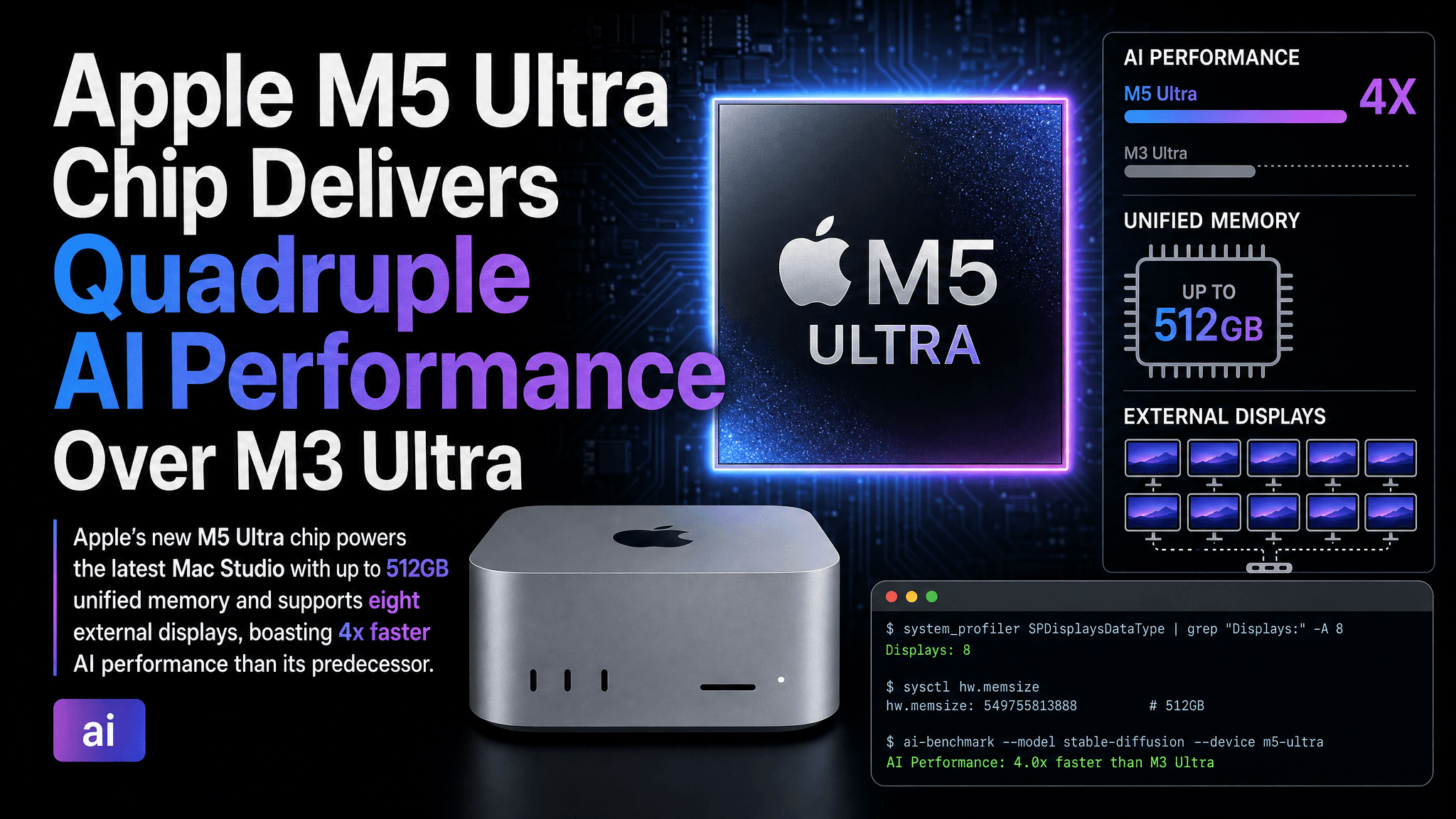
Apple’s new M5 Ultra chip powers the latest Mac Studio with up to 512GB unified memory and supports eight external displays, boasting 4x faster AI performance than its predecessor.
Apple has unveiled its most powerful chip to date, the M5 Ultra, which significantly boosts AI performance and memory capacity for professional users. The M5 Ultra will be featured in the new Mac Studio, targeting demanding workflows that benefit from high compute throughput and large unified memory pools.
Key Features of the M5 Ultra
The standout specification of the M5 Ultra is its AI performance, which Apple claims is four times faster than the previous M3 Ultra chip. This level of improvement is substantial, especially for tasks involving machine learning, neural network inference, and other AI-accelerated workloads that are increasingly common in creative and scientific applications.
In addition to raw performance, the M5 Ultra supports up to 512GB of unified memory. This is a notable jump from earlier models and allows for handling extremely large datasets and complex multitasking scenarios without resorting to slower external memory solutions. Unified memory architecture means the CPU, GPU, and neural engines share the same memory pool, reducing latency and improving overall efficiency.
The chip also enables driving up to eight external displays, catering to professionals who require expansive multi-monitor setups for video editing, 3D rendering, software development, or data analysis.
Technical and Practical Implications
While Apple has not released detailed benchmarks or architectural breakdowns yet, the 4x AI performance increase suggests significant enhancements in the neural engine or dedicated AI accelerators within the chip. For engineers and developers working with AI models on macOS, this could translate into faster training iterations, real-time inference capabilities, and more complex model deployment directly on the device.
The massive unified memory capacity is particularly relevant for workflows that traditionally rely on large RAM pools, such as virtualization, large-scale simulations, or high-resolution video editing. By integrating this memory directly on the chip, Apple reduces the overhead and bottlenecks associated with separate memory modules.
Supporting up to eight external displays also reflects a focus on professional users who need extensive screen real estate. This capability can improve productivity for software developers, data scientists, and creative professionals who juggle multiple applications and data visualizations simultaneously.
Context in the Broader Hardware Landscape
Apple’s M-series chips have steadily pushed the boundaries of performance per watt and integration since their introduction. The M5 Ultra continues this trend by scaling AI capabilities and memory to levels that are uncommon in desktop-class chips from other vendors. While Intel and AMD have made strides in AI acceleration and memory support, Apple’s tight hardware-software integration gives it an edge in delivering efficient, high-throughput AI workloads.
From a Linux and open systems perspective, the M5 Ultra’s advancements highlight the growing importance of AI acceleration in general-purpose computing. Although Apple’s chips are not natively supported by Linux, the performance gains in AI may pressure other hardware vendors and open-source communities to prioritize AI workloads in their architectures and drivers.
What This Means for Engineers and Practitioners
For practical Linux, automation, cloud, and AI engineers, Apple’s M5 Ultra sets a new bar for integrated AI performance and memory capacity in desktop-class hardware. While the Mac Studio with M5 Ultra is a macOS-centric platform, the hardware trends it embodies—such as large unified memory and dedicated AI accelerators—are increasingly relevant across computing environments.
Engineers should watch how software ecosystems evolve to leverage these hardware capabilities, particularly in AI frameworks and development tools optimized for Apple silicon. For those working in cross-platform environments, understanding the performance characteristics of Apple’s latest silicon can inform decisions about hardware procurement and workload distribution.
In summary, the M5 Ultra represents a significant leap in Apple’s silicon roadmap, emphasizing AI performance and memory scalability. It challenges the status quo of desktop computing power and will likely influence future hardware designs across the industry.
Comments
Sign in or create an account to leave a comment.
0 comments
No comments yet.