/news/canonical-frames-the-ai-harness-challenge-for-telco-autonomous-networks-dc945f6f
Canonical frames the AI harness challenge for telco autonomous networks
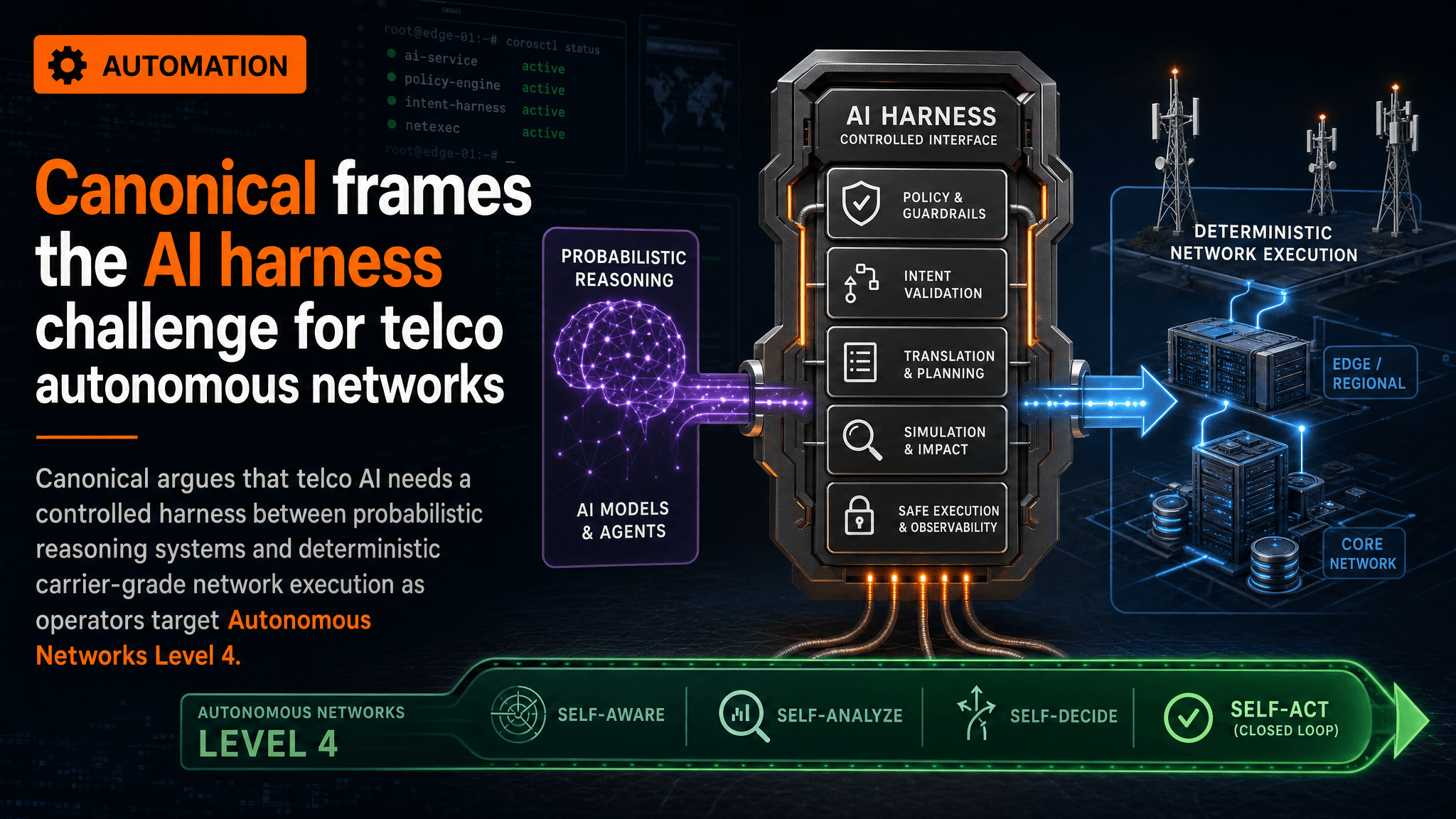
Canonical argues that telco AI needs a controlled harness between probabilistic reasoning systems and deterministic carrier-grade network execution as operators target Autonomous Networks Level 4.
Canonical has put a useful name to one of the harder problems in telecom automation: the AI harness.
In a new post on autonomous networks, the company argues that moving toward Autonomous Networks Level 4 is not simply a matter of attaching a large language model or agent framework to network operations tooling. The architectural problem is building a secure, reliable and interoperable layer that can translate probabilistic AI reasoning into deterministic, carrier-grade network actions.
That distinction matters. Networks already have automation systems, operational runbooks, policy engines and controllers. AI may improve how those systems are queried, coordinated or operated, but it does not remove the need for predictable execution, bounded permissions and recoverable change paths.
The gap between an agent and a network action
AI systems are useful partly because they can work through ambiguous inputs. An operator can ask for an explanation of a service degradation, request a proposed remediation plan, or provide incomplete context about an incident. A model can summarize alarms, connect related events and suggest a sequence of checks.
That behavior is inherently probabilistic. The same prompt can yield different wording, different prioritization or, in a poorly designed system, an unsupported conclusion. This is tolerable in an assistant that drafts a ticket or helps an engineer find documentation. It is a different proposition when the output can trigger a configuration update, change routing behavior, alter capacity settings or affect a live subscriber service.
Carrier-grade execution has the opposite expectation. A requested operation needs a known target, an authorized scope, validated inputs, explicit preconditions and an auditable result. Failures must have understandable handling. Operators also need to know whether a change completed, partially completed, was rejected by policy or should be rolled back.
Canonical's use of “AI harness” describes the layer needed to bridge those two operating models. The important point is not that AI should be excluded from network operations. It is that AI output cannot be treated as a direct network command merely because it appears plausible.
Level 4 raises the bar
The post places this architectural challenge in the context of the telecom industry's transition toward Autonomous Networks Level 4. Canonical characterizes the target as a stage where the operational system has substantially more autonomy, making the control boundary around AI more consequential.
For engineering teams, autonomy should not be confused with unrestricted action. A system can automate a wide range of operational decisions while still being constrained by policy, ownership boundaries and defined failure behavior. In practice, the more systems a workflow crosses, the more important those constraints become.
A network remediation flow may touch fault management, inventory, service orchestration, configuration management, assurance data and domain-specific controllers. Each component can have its own data model, API semantics and authorization model. An AI-facing layer that does not account for those differences can turn a useful operational assistant into a source of fragile integration logic.
The harness, as Canonical frames it, therefore has to handle more than model access. It must provide the path between reasoning and execution without losing the properties operators expect from production network automation.
Security and interoperability are not secondary concerns
Canonical explicitly identifies security, reliability and interoperability as requirements for this architecture. Those are not implementation details to add after an agent demonstration works.
Security starts with authority. An AI system should not receive broad standing access to every network function simply because it may need to answer a question or coordinate a workflow. Engineers will need clear separation between observing state, proposing actions, requesting approval and executing an approved operation. The allowed action set should be deliberate and narrow enough to inspect.
Reliability means treating execution as an engineering workflow rather than a conversational continuation. A natural-language request may initiate the work, but the execution path needs structured parameters, validation and observable outcomes. If the underlying system cannot safely perform an action, the AI layer should expose that limit rather than inventing confidence.
Interoperability is equally important in telecom environments, where network domains and operational tools are commonly supplied by different vendors. A harness tied tightly to one model provider, one controller or one proprietary action format may create a new operational silo. Canonical's framing suggests that the integration layer must be able to mediate between AI systems and the deterministic systems responsible for network execution.
What engineers should look for
The practical test for an AI harness is not the quality of a chat interface. It is whether an operations team can define and enforce a safe chain from intent to outcome.
That chain should make several questions answerable: What information did the AI use? Which tools was it allowed to call? What policy permitted the action? Which network system executed it? What changed? How can the result be verified? What happens if a downstream operation fails?
Teams evaluating autonomous-network tooling should also distinguish recommendations from actions. A system that summarizes telemetry and proposes a change is useful, but it has a different risk profile from one that can enact the change. Those modes should be visible in the design, not implied by a prompt.
Canonical's post does not present the challenge as a model-selection problem. Its central argument is architectural: AI reasoning and carrier-grade execution need a controlled interface between them.
That is the practical takeaway. Telcos pursuing higher levels of autonomy will get more value from AI when it is connected to explicit policies, bounded tools and deterministic automation paths. The difficult work is building that control plane around the model, so a helpful inference can become a safe, accountable network operation.
Comments
Sign in or create an account to leave a comment.
0 comments
No comments yet.