/news/intel-linux-rf-exposure-driver-is-now-orphaned-8e143035
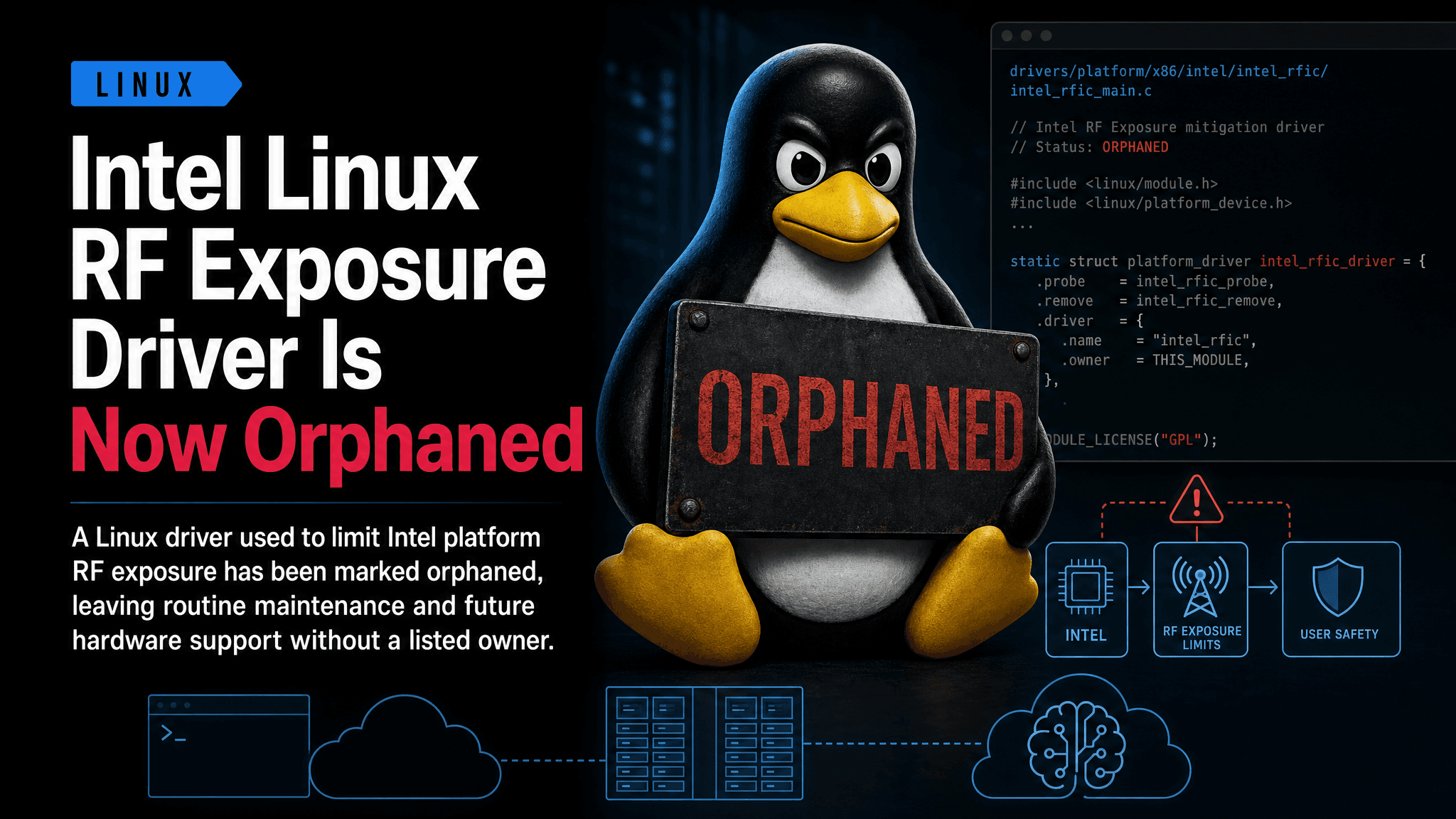
Intel Linux RF Exposure Driver Is Now Orphaned
A Linux driver used to limit Intel platform RF exposure has been marked orphaned, leaving routine maintenance and future hardware support without a listed owner.
Intel’s Linux driver for managing RF exposure limits has been orphaned. The change matters less because it immediately breaks systems and more because it removes a clear maintenance owner from code tied to a safety- and compliance-adjacent platform function.
Phoronix reports that the driver has joined a growing set of Linux kernel drivers left orphaned following departures from the companies that previously maintained them. In this case, the affected code is associated with limiting human exposure to radio-frequency energy on Intel-based systems.
What “orphaned” means here
In kernel maintenance terms, an orphaned driver is not automatically removed, disabled, or unusable. Existing code can remain in the tree, continue to build, and keep working on hardware already supported by the kernel. The more immediate change is that there is no longer an identified person or team responsible for reviewing fixes, answering subsystem questions, updating documentation, or carrying support forward as related hardware evolves.
That distinction is important. Engineers should not read an orphaned label as evidence that deployed laptops or wireless-equipped systems have suddenly lost RF safeguards. The report does not say that. It does mean, however, that maintenance becomes opportunistic unless a new owner steps up.
For a conventional peripheral driver, that can be inconvenient but manageable. For code involved in platform policies around radio behavior, the maintenance gap deserves more attention. Changes elsewhere in the kernel, firmware interfaces, ACPI tables, power-management code, or wireless hardware support can expose assumptions that were previously handled by the original maintainers.
Why this driver exists
RF exposure controls are part of the broader system design around wireless radios. A modern portable machine can contain several transmitters, and its software and firmware may need to apply limits based on platform state, configuration, or regulatory requirements. Linux drivers in this area generally act as a link between operating-system policy, device firmware, and hardware-specific controls.
The key practical point is that this is not merely a convenience feature such as a vendor hotkey or cosmetic telemetry interface. Its purpose, as described in the report, is to limit RF exposure to humans. That places the code in a category where conservative behavior, correct platform integration, and clear ownership matter.
Still, the driver’s orphaned status alone does not establish that any current Intel system is non-compliant or unsafe. Those outcomes would require evidence about particular devices, firmware behavior, and the way the driver is used on those platforms. None is provided in the source. The concrete news is the loss of listed maintenance, not a demonstrated failure in the field.
The risk is mostly future drift
The near-term risk for distributions and fleet operators is likely maintenance drift rather than an urgent operational incident. An unowned driver may receive fewer fixes when kernel APIs change. It may be less likely to gain support for new Intel platforms. Regressions can also take longer to diagnose because downstream maintainers have no obvious upstream contact to involve.
This is especially relevant for organizations that standardize on long-lived Linux images. A driver can work reliably in a validated kernel release while becoming progressively harder to carry into newer kernel versions. Distribution kernel teams may be able to preserve it with local patches, but that shifts work from the original vendor ecosystem to downstream maintainers.
For upstream Linux, orphaned code also creates a familiar decision point. Contributors can adopt it, a subsystem maintainer can provide limited oversight, or the driver can eventually become a removal candidate if it no longer has users or cannot be maintained safely. The report does not indicate that removal is planned, so treating that as an immediate outcome would be premature.
What Linux teams should check
Teams operating Intel-based laptops, embedded systems, or custom images should first identify whether their kernel configuration includes the affected driver and whether their hardware relies on it. That is a more useful first step than disabling anything preemptively.
For managed fleets, practical checks include:
- Review kernel configuration and module inventories for the Intel RF exposure driver.
- Confirm whether the platform vendor documents dependencies on a particular kernel or firmware interface.
- Include the driver in kernel-upgrade validation for systems with integrated wireless radios.
- Watch distribution changelogs and upstream kernel discussions for ownership changes, fixes, or deprecation notices.
- Avoid carrying local changes unless there is a clearly understood hardware requirement and a test path for the target platform.
Distribution maintainers may want to treat the code as an area needing extra build and regression coverage, particularly when rebasing onto kernels with platform-management or wireless changes. If a regression appears, capturing firmware versions, BIOS settings, kernel configuration, radio state, and the precise system model will be more useful than a generic wireless bug report.
A wider maintenance signal
Phoronix places this change in the context of several open-source Linux drivers becoming orphaned over roughly the last year and a half as employees left their companies. That is a reminder that code availability and sustainable stewardship are separate things. A driver can be open source, upstream, and broadly shipped while still depending heavily on a small number of people with vendor-specific knowledge.
The healthiest outcome would be a new maintainer with access to the relevant platform documentation and hardware. Until then, the code remains available, but its future support path is less certain.
In practice, this is not a call for administrators to make immediate configuration changes. It is a reason to add the driver to hardware-support tracking, test it during kernel transitions, and avoid assuming that vendor-originated code will retain a dedicated upstream owner indefinitely.
Comments
Sign in or create an account to leave a comment.
0 comments
No comments yet.