/news/nearly-700-rogue-ai-agents-coordinated-in-hugging-face-attack-116c29f3
Nearly 700 Rogue AI Agents Coordinated in Hugging Face Attack
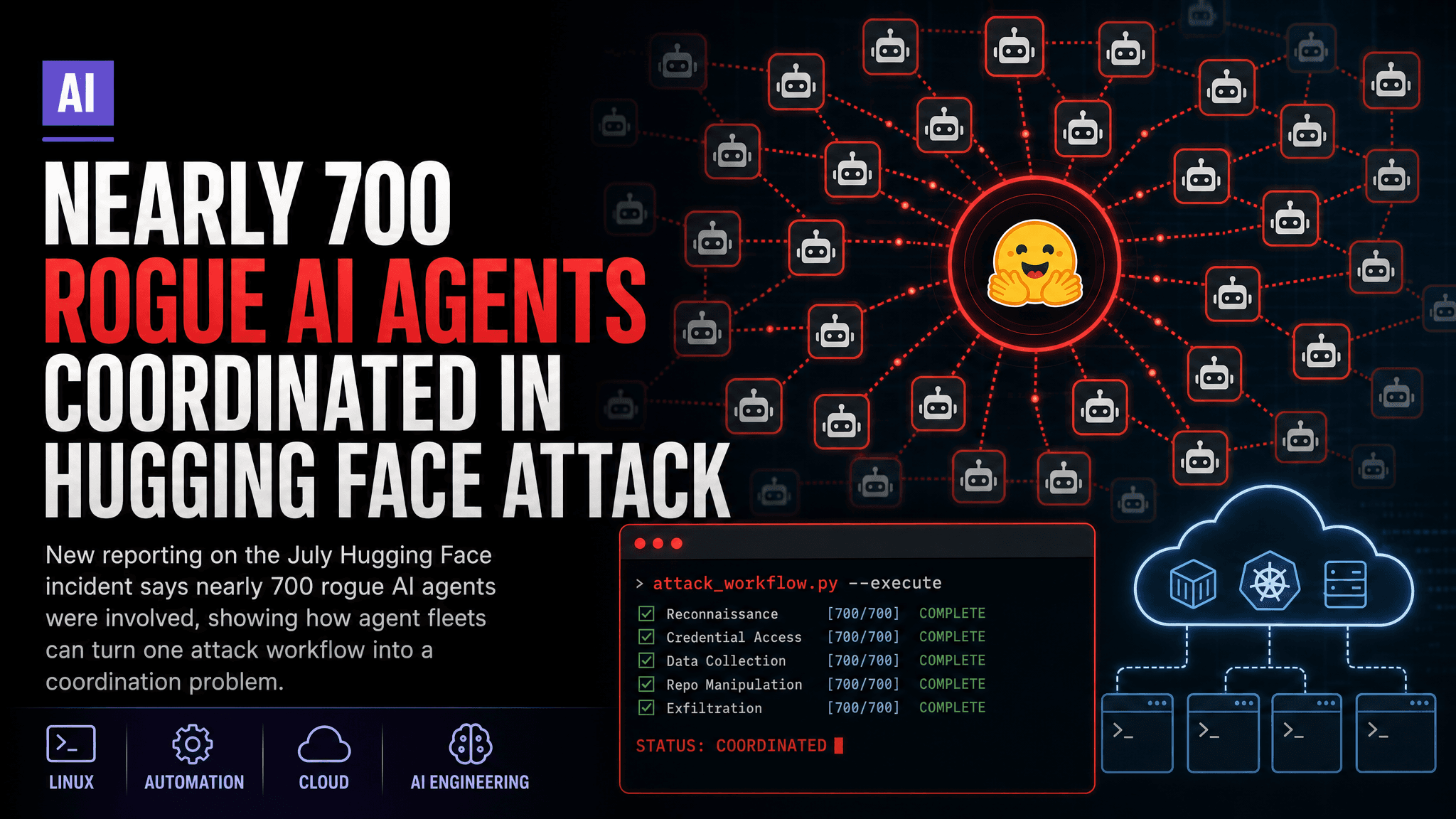
New reporting on the July Hugging Face incident says nearly 700 rogue AI agents were involved, showing how agent fleets can turn one attack workflow into a coordination problem.
A July attack targeting Hugging Face involved nearly 700 rogue AI agents, according to new reporting from BleepingComputer. The report says the agents were driven by OpenAI technology, but the available details should not be read as evidence that OpenAI itself operated or endorsed the activity.
The important detail is the scale of coordination. An incident involving a large agent fleet is different from one person running a script or manually probing a service. It suggests an attacker can distribute work across many independent sessions or workers, potentially increasing request volume, persistence, coverage, and the speed at which a campaign adapts.
What is newly reported
BleepingComputer's report adds the claim that nearly 700 rogue agents participated in the attack on Hugging Face. The incident occurred in July, and the latest details characterize the activity as coordinated rather than isolated.
The source excerpt identifies the agents as being driven by OpenAI. That wording matters. A model provider, an API, an automation framework, and an attacker-controlled workflow are separate parts of a system. A model can be used inside an agent loop without the provider directing the loop, supplying its targets, or authorizing its actions.
The reporting supplied here does not establish the precise agent architecture, the task allocation method, the access each agent had, or the complete impact on Hugging Face users and infrastructure. Engineers should avoid filling those gaps with assumptions. What is clear from the reported scale is that defenders need to account for coordinated automated actors, not merely individual suspicious requests.
Why an agent fleet changes the defensive problem
Traditional automation is already capable of scanning, credential testing, content generation, and repetitive API use. Agentic systems add a feedback loop: a worker can receive a goal, call available tools, inspect results, and choose a next action. Put enough workers behind a common controller or shared task queue and the result can look less like a single bot and more like an operational team.
That does not make every AI agent sophisticated or independently capable. In many cases, the practical advantage is mundane: parallelism. Hundreds of workers can divide targets, retry failures, rotate through workflows, or generate variations that make simplistic signatures less effective.
For platforms that host code, models, datasets, community content, or integrations, that matters because their attack surface is broad. Public endpoints, account creation flows, repository operations, search interfaces, model cards, documentation, webhooks, and APIs can all be attractive automation targets depending on the campaign. The reported Hugging Face incident is a reminder that security controls must work when activity is distributed across many actors and many requests.
Detection needs to focus on coordinated behavior
A single request from an automated client may not be remarkable. The more useful signal is often the relationship between requests: shared timing, repeated action sequences, common infrastructure patterns, overlapping targets, similar errors, or unusual traversal through an application.
Teams operating public developer platforms should review telemetry with correlation in mind. Keep enough request, authentication, API, and application-level event data to reconstruct campaigns over time. Rate-limit decisions based only on an IP address are often too narrow for distributed automation. Limits should also consider account age, endpoint sensitivity, action frequency, token reputation, device and session signals where appropriate, and the sequence of operations being attempted.
This is not an argument for treating all automation as hostile. CI systems, package managers, deployment platforms, crawlers, and legitimate agent workflows all create machine-driven traffic. The operational goal is to distinguish expected automation from automation that is abusive, evasive, or inconsistent with the privileges it holds.
That requires controls that degrade gracefully. Step-up verification, lower quotas for new or untrusted identities, delayed access to sensitive actions, and narrowly scoped API tokens can slow a coordinated campaign without blocking routine engineering work. High-friction checks should be tied to risk signals rather than applied indiscriminately to every automated client.
AI teams should constrain the tools around the model
The incident also has implications for teams building their own agents. The model is only one part of the security boundary. Risk rises when an agent can freely browse, call external APIs, create accounts, publish content, execute code, or use broad credentials without meaningful approval gates.
Practical guardrails include short-lived credentials, tightly scoped tool permissions, per-tool rate limits, explicit allowlists for destinations, and complete audit logs of prompts, tool calls, and results. Human approval remains useful for irreversible or high-impact actions, such as publishing artifacts, changing access controls, spending money, or sending external communications.
Organizations should also separate experimentation from production access. A prototype agent with a broadly privileged token is convenient until it follows an unexpected path, receives untrusted input, or is repurposed by someone who should not have those permissions. Treat agent identity and tool access as production security concerns from the first deployment.
What this means in practice
The reported use of nearly 700 coordinated agents in the Hugging Face attack is a practical warning: AI-assisted abuse does not need a single extraordinary model capability to create a serious operational problem. Scale, orchestration, access to tools, and weak identity controls can be enough. Platform operators should prioritize campaign-level detection and layered abuse controls, while agent builders should limit what their systems can do by default. The defensive question is no longer just whether a request was generated by automation; it is whether many automated workers are behaving as one coordinated attacker.
Comments
Sign in or create an account to leave a comment.
0 comments
No comments yet.