/news/ubuntu-26-04-1-lts-arrives-as-first-maintenance-update-fdaea5fd
Ubuntu 26.04.1 LTS Arrives as First Maintenance Update
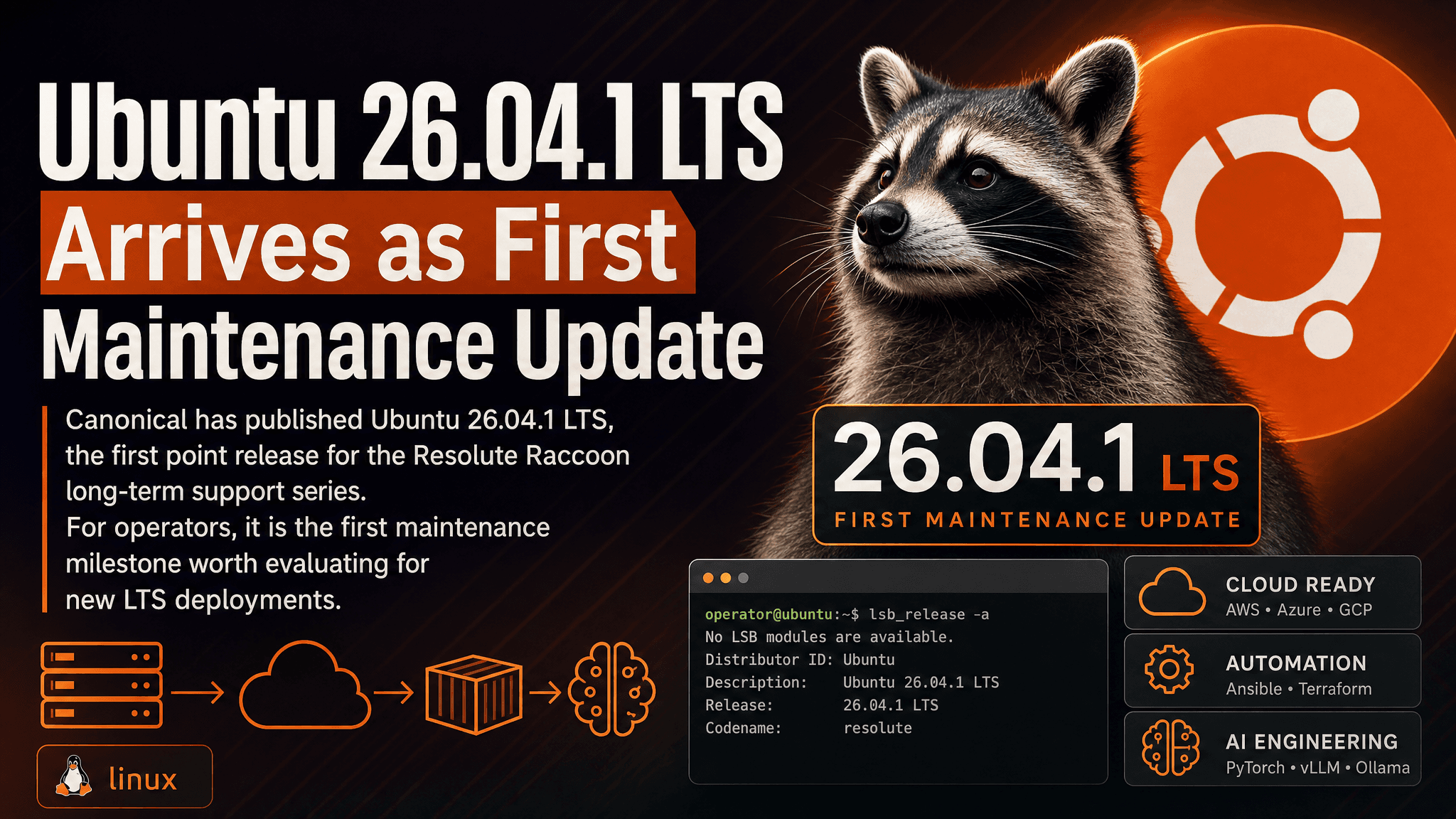
Canonical has published Ubuntu 26.04.1 LTS, the first point release for the Resolute Raccoon long-term support series. For operators, it is the first maintenance milestone worth evaluating for new LTS deployments.
Canonical has published Ubuntu 26.04.1 LTS, the first point release in the Ubuntu 26.04 LTS “Resolute Raccoon” series, according to Phoronix.
This is a maintenance release rather than a new Ubuntu branch. Its practical importance is timing: the first point release is often the point at which teams that intentionally waited through the initial LTS launch begin evaluating the release for broader use.
What Ubuntu 26.04.1 LTS represents
Ubuntu point releases collect fixes delivered since the original LTS release into a refreshed release milestone. That matters most for teams that are installing Ubuntu from scratch, provisioning repeatable images, or maintaining internal platform baselines.
A newly installed system based on a point release should need fewer post-install updates than a system installed from the original 26.04 media and then fully updated. In a large fleet, that can reduce first-boot patch churn, shorten image-build pipelines, and make a documented baseline easier to reproduce.
The key point is that 26.04.1 is still Ubuntu 26.04 LTS. It is not a separate upgrade track and should not be treated as a reason to redesign an existing 26.04 deployment. Systems already running Ubuntu 26.04 and receiving normal updates should already have accumulated the maintenance fixes represented by the point-release milestone.
Why the first point release changes deployment decisions
Many infrastructure teams use the first point release as a policy gate rather than adopting an LTS on day one. That is not because the initial LTS release is inherently unsuitable; it is because early production experience tends to expose the integration issues that matter in real estates: installer paths, hardware enablement, cloud image behavior, package interactions, and upgrade tooling.
The first maintenance milestone provides a cleaner time to reassess those risks. It also gives platform teams a stable label for documentation. Instead of telling internal users to install “26.04 and immediately apply all updates,” a team can validate a defined 26.04.1 baseline, publish an image derived from it, and track exceptions from there.
For cloud and automation work, the distinction is especially useful. Immutable image pipelines, PXE environments, VM templates, CI runners, and ephemeral build workers all benefit from a known starting point. A refreshed point release can lower the amount of boot-time remediation required before a node reaches the organization’s intended state.
That said, the point-release number is not a substitute for testing the exact stack you operate. Kernel-dependent software, GPU workloads, out-of-tree drivers, endpoint tooling, Kubernetes node configuration, and vendor agents can all have constraints that are independent of Ubuntu’s maintenance cadence.
What to validate before changing your baseline
The Phoronix report identifies 26.04.1 as the initial collection of fixes for the LTS series, but the supplied source excerpt does not enumerate individual fixes, package versions, kernel revisions, installer changes, or hardware-enablement details. Teams should therefore avoid assuming that any particular bug affecting their environment is resolved solely because this point release exists.
A practical validation pass should start with the deployment path, not just a desktop or single virtual machine boot:
- Build a fresh image from the 26.04.1 baseline and compare installed package state with your current 26.04 image after normal updates.
- Run unattended installation or cloud-init workflows end to end, including proxy, mirror, repository, and identity configuration.
- Test the kernel-facing parts of the stack: storage, network adapters, virtualization drivers, GPUs where relevant, and any externally supplied modules.
- Re-run configuration management convergence with Ansible, Puppet, Salt, or the tooling used in your environment. Look for package renames, service ordering assumptions, and repository pinning problems.
- Exercise in-place upgrade and rollback procedures in a disposable environment if 26.04 adoption is planned from an earlier Ubuntu release.
- Check application observability before broad rollout. A baseline is only useful if logs, metrics, security agents, and backup clients all arrive in a working state.
For managed cloud estates, also verify the image identity and publication channel you consume. A distribution point release does not automatically mean every cloud image catalog, marketplace entry, or internal golden-image pipeline has switched at the same time. Treat the image version selected by your provisioning system as the source of truth for an actual deployment.
Existing 26.04 systems should not need a reinstall
The operational model for an Ubuntu point release is straightforward: it packages a maintenance state for fresh installations. Organizations already tracking Ubuntu 26.04 updates normally should not need to rebuild machines merely to claim the 26.04.1 label.
There can still be reasons to rebuild. Some teams use every point release as an opportunity to retire drifted hosts, refresh base images, or validate disaster-recovery procedures. Those are sound operational exercises, but they are local policy choices rather than an inherent requirement of the point release.
Conversely, teams that deferred 26.04 adoption can now use 26.04.1 as a concrete evaluation target. Keep the rollout staged: start with CI, noncritical services, and representative hardware or cloud instance types. Promote only after the same image, automation, and application checks pass under the conditions that matter for production.
What this means in practice
Ubuntu 26.04.1 LTS is a useful maintenance marker for engineers standardizing on the Resolute Raccoon LTS line. It gives new deployments a refreshed starting point and gives cautious adopters a sensible moment to begin—or resume—qualification. But the release number does not replace a changelog review and a workload-specific test plan. Use it to refresh your image baseline, then verify the parts of the system Ubuntu cannot know about: your hardware, repositories, automation, security tooling, and applications.
Comments
Sign in or create an account to leave a comment.
0 comments
No comments yet.