/news/wayland-outperforms-x11-in-speed-but-not-always-efficiency-study-finds-122d0f0a
Wayland Outperforms X11 in Speed but Not Always Efficiency, Study Finds
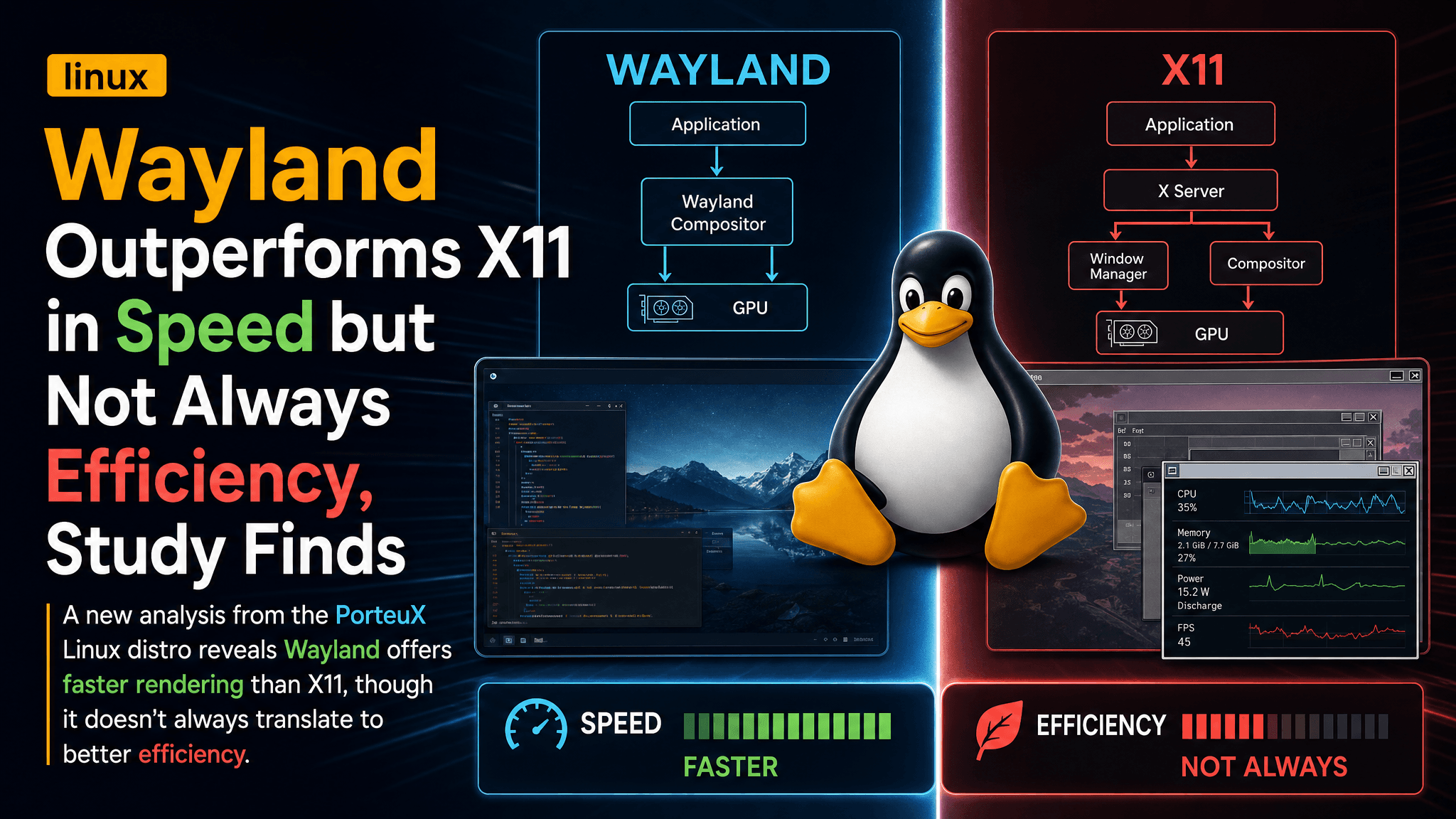
A new analysis from the PorteuX Linux distro reveals Wayland offers faster rendering than X11, though it doesn't always translate to better efficiency.
The ongoing debate between Wayland and X11 as Linux's display server protocol has gained fresh insights thanks to work done by the PorteuX Linux distribution. PorteuX, known for its focus on high performance and modularity, recently forked the Xfce window manager xfwm4 to create xfwm4-gl, enabling OpenGL compositing support. This effort provided a practical testbed to compare Wayland and X11 performance under real-world conditions.
Background: Wayland vs. X11
X11 has been the longstanding display server protocol for Unix-like systems, but its architecture is considered legacy and sometimes inefficient for modern graphics workloads. Wayland was designed as a simpler, more modern replacement, aiming to reduce overhead and improve rendering speed by streamlining communication between applications and the compositor.
PorteuX’s Approach
By modifying xfwm4 to support OpenGL compositing (xfwm4-gl), PorteuX created a scenario where both Wayland and X11 could be benchmarked using similar graphical workloads. This approach allowed for a more apples-to-apples comparison, focusing on how each protocol handles compositing and rendering tasks.
Key Findings
The results showed that Wayland is "intrinsically faster" than X11. This means that, at a fundamental level, Wayland can render frames quicker due to its more efficient design and reduced protocol overhead. However, the study also found that this speed advantage does not always translate into better overall efficiency. Efficiency here refers to resource usage such as CPU and GPU load, power consumption, and smoothness under varying workloads.
In some scenarios, X11's mature and highly optimized codebase can still compete or even outperform Wayland in terms of resource efficiency. This suggests that while Wayland has architectural advantages, the ecosystem and software maturity around X11 still provide practical benefits.
What This Means for Engineers
For Linux engineers working with graphics stacks, this insight is valuable. It indicates that migrating to Wayland can yield performance gains, especially in rendering speed, but it should not be assumed to automatically improve efficiency across all workloads. Careful profiling and testing remain essential when choosing or tuning display server protocols for specific use cases.
The PorteuX project’s xfwm4-gl fork also highlights the importance of compositors supporting modern graphics APIs like OpenGL to fully leverage Wayland’s capabilities. Engineers should consider the compositor and window manager maturity alongside the display server protocol when optimizing Linux graphical environments.
Conclusion
Wayland's design offers a clear speed advantage over X11, but efficiency gains are context-dependent. The PorteuX Linux distro’s practical experiments remind us that real-world performance involves multiple factors beyond raw protocol speed. For those building or maintaining Linux systems with graphical workloads, this nuanced understanding helps balance performance improvements against resource usage and stability needs.
Comments
Sign in or create an account to leave a comment.
0 comments
No comments yet.