
/news/amd-zen-6-preparations-ryzen-ai-halo-led-driver-many-laptop-changes-for-linux-7--a93a0499
AMD Zen 6 Preparations, Ryzen AI Halo LED Driver & Many Laptop Changes For Linux 7.3
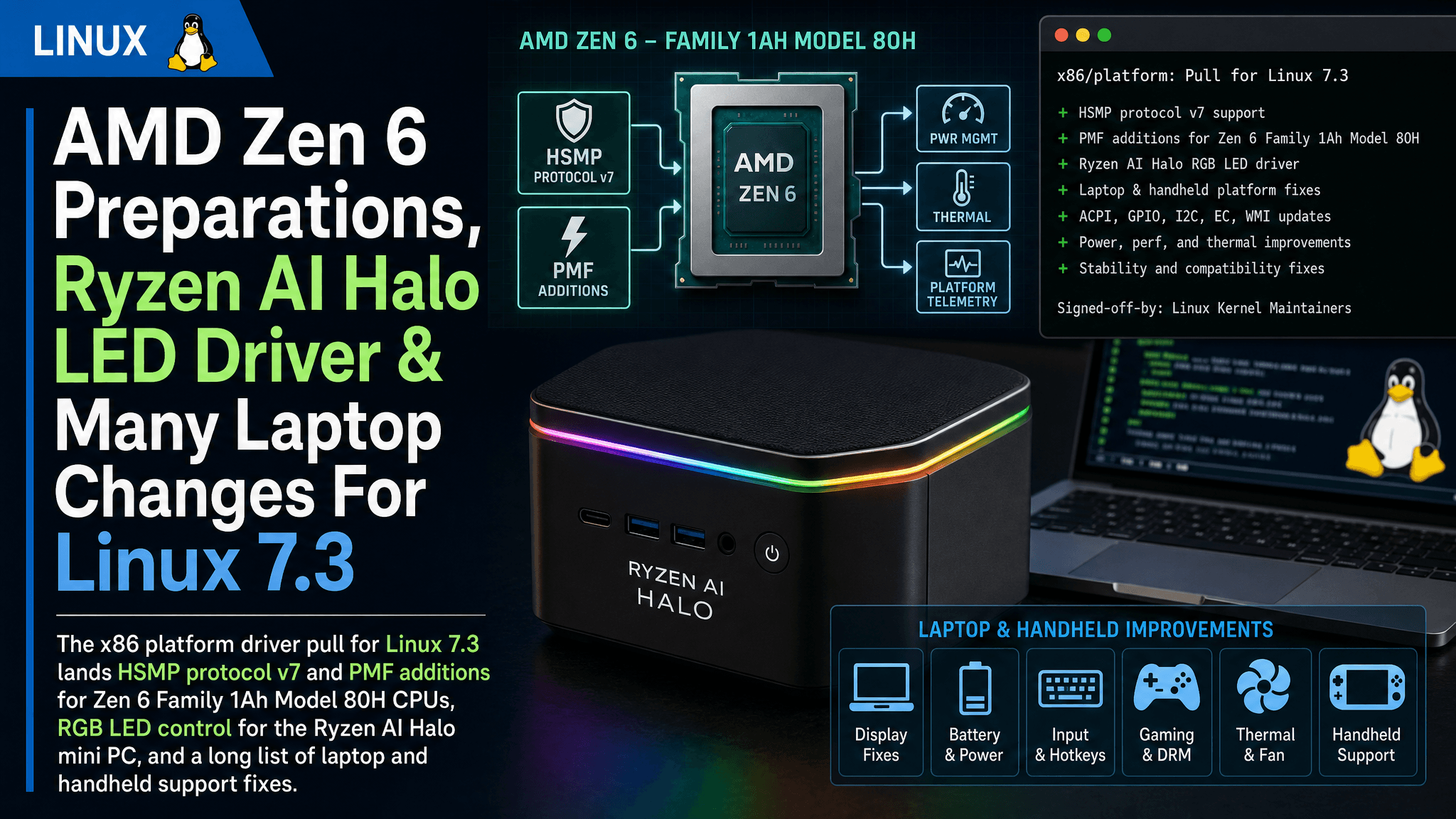
The x86 platform driver pull for Linux 7.3 lands HSMP protocol v7 and PMF additions for Zen 6 Family 1Ah Model 80H CPUs, RGB LED control for the Ryzen AI Halo mini PC, and a long list of laptop and handheld support fixes.
The x86 platform driver pull request for Linux 7.3 has landed. Platform drivers rarely make headlines, but this batch is worth reading if you run AMD hardware or maintain a laptop fleet. It contains the first concrete mainline preparations for Zen 6 silicon, LED control for AMD's Ryzen AI Halo mini PC, and a wide sweep of laptop and handheld fixes from HP, Lenovo, ASUS, MSI, LG, Samsung and the Uniwill-based vendors.
First Zen 6 groundwork in mainline
The forward-looking piece sits in AMD's HSMP (Host System Management Port) driver, which has gained protocol v7 support. That protocol version is used by Family 1Ah Model 80H processors — in AMD's APIC numbering, Family 1Ah is the Zen 5 generation family, and Model 80H marks the next hardware revision that will carry Zen 6. Kernel-side protocol bumps this early are unusual for hardware that has not shipped, so this is preparation work: when the parts arrive, the sysfs telemetry and power-management interface HSMP exposes will already speak their language.
The AMD PMF (Platform Management Framework) driver picked up additions for the same Family 1Ah Model 80H parts, which given AMD's current naming conventions presumably correspond to the Zen 6 client desktop models. PMF coordinates power and thermal modes on modern Ryzen laptops and desktops, so having it keyed to the new model IDs ahead of launch means fewer boot-time surprises for early adopters.
A change relevant to today's hardware also landed: the PMF driver now exposes device metrics through a new ioctl interface, giving userspace tools a cleaner channel to read platform telemetry than the file-based attributes it relied on before.
Ryzen AI Halo lighting comes to mainline
A new LED driver merged for the Ryzen AI Halo mini PC allows toggling the device's LEDs and RGB lighting from a mainline kernel. The Halo is an interesting machine in AMD's lineup — a mini PC built on Ryzen AI Max+ silicon, and notably one that ships with AMD's own in-house Linux distribution. Until now, lighting control was presumably confined to that out-of-tree or vendor distribution; from Linux 7.3 the standard mainline kernel can drive the device's lighting configuration directly.
That removes one more reason for Halo owners to run a vendor fork.
Handhelds and the usual laptop sprawl
The handheld gaming segment keeps demanding kernel attention, and this pull delivers. The MSI WMI driver now supports the M Center keys on the MSI Claw. The OneXPlayer "OXPEC" driver gained support for the OneXPlayer X2 Mini Pro.
Laptop changes, by vendor:
- AMD PMC: the Lenovo ThinkPad T14 Gen2 AMD (20XL) gets an s2idle quirk — one of those unglamorous but essential fixes for suspend behavior on a common corporate machine.
- HP WMI: GPU MUX switching support arrives, allowing toggling between hybrid and discrete-only graphics paths, plus independent CPU and GPU PWM fan control. New device support covers the OMEN 16-n0xxx, OMEN 16-wd0xxx, OMEN 16-wf0xxx, OMEN 16-ak0xxx, OMEN board ID 8D88, and the Transcend 16-u0xxx lines.
- Lenovo ThinkPad ACPI: a new driver,
yb9-kbdock, supports the Yoga Book 9 14IAH10, and newer ThinkPads gain the USB-C Security (USCS) feature — a mode where USB-C devices can charge while data transfer is blocked. For anyone who plugs into airport or hotel USB-C ports, that is a genuinely useful security posture control exposed at the firmware platform layer. - ASUS: the NB WMI driver adds the "ProArt" key on the ProArt PX13, and the Armoury driver can adjust power limits on more devices.
- LG: the LG laptop platform driver now handles various events found on newer models, and the LG Gram 16T90SP gets fixed keyboard backlight support.
- Samsung: the Galaxy Book6 Pro is now supported by the galaxybook platform driver.
- Uniwill: the driver maintained heavily by TUXEDO Computers for their hardware gains keyboard backlight, AC auto boot, and USB power-share support, and adds the MACHENIKE L16 Pro, AiStone X4SP4NAL, and Avell A60 MUV laptops.
- MSI EC: the Raider A18 HX A9WJG and Katana GF76 11UEK are now supported.
Why this batch matters
These changes are not architectural, and that fits the job. Platform drivers are where Linux hardware support becomes usable — fan control, suspend quirks, keyboard backlights, performance modes, MUX switches. A machine that boots fine but cannot switch to its dGPU or come back from s2idle is not a supported machine in any practical sense. This pull closes those gaps across a lot of hardware that will still be on desks and in backpacks for years.
The Zen 6 preparation is the part to watch over time. HSMP protocol v7 and PMF model-ID additions landing before the hardware ships is the usual rhythm, and it means the odds are decent that day-one Zen 6 systems will have their platform management handled by the distribution kernel rather than waiting on out-of-tree patches. Combined with the ioctl-based PMF metrics interface, userspace tooling around AMD power management should also get more uniform going forward.
For system administrators and distro maintainers, the practical takeaway is simple: Linux 7.3 will be the kernel where a meaningful slice of recent and upcoming x86 laptop and mini-PC hardware becomes first-class. If you are tracking a specific machine — an OMEN 16, a Galaxy Book6 Pro, a ThinkPad T14 Gen2 AMD with flaky s2idle — this is the kernel series that addresses it, and it will be the one to target for your next validation cycle.
Comments
Sign in or create an account to leave a comment.
0 comments
No comments yet.