
/news/chatgpt-work-in-a-small-business-five-tasks-that-actually-save-time-2b67dbfe
ChatGPT Work in a Small Business: Five Tasks That Actually Save Time
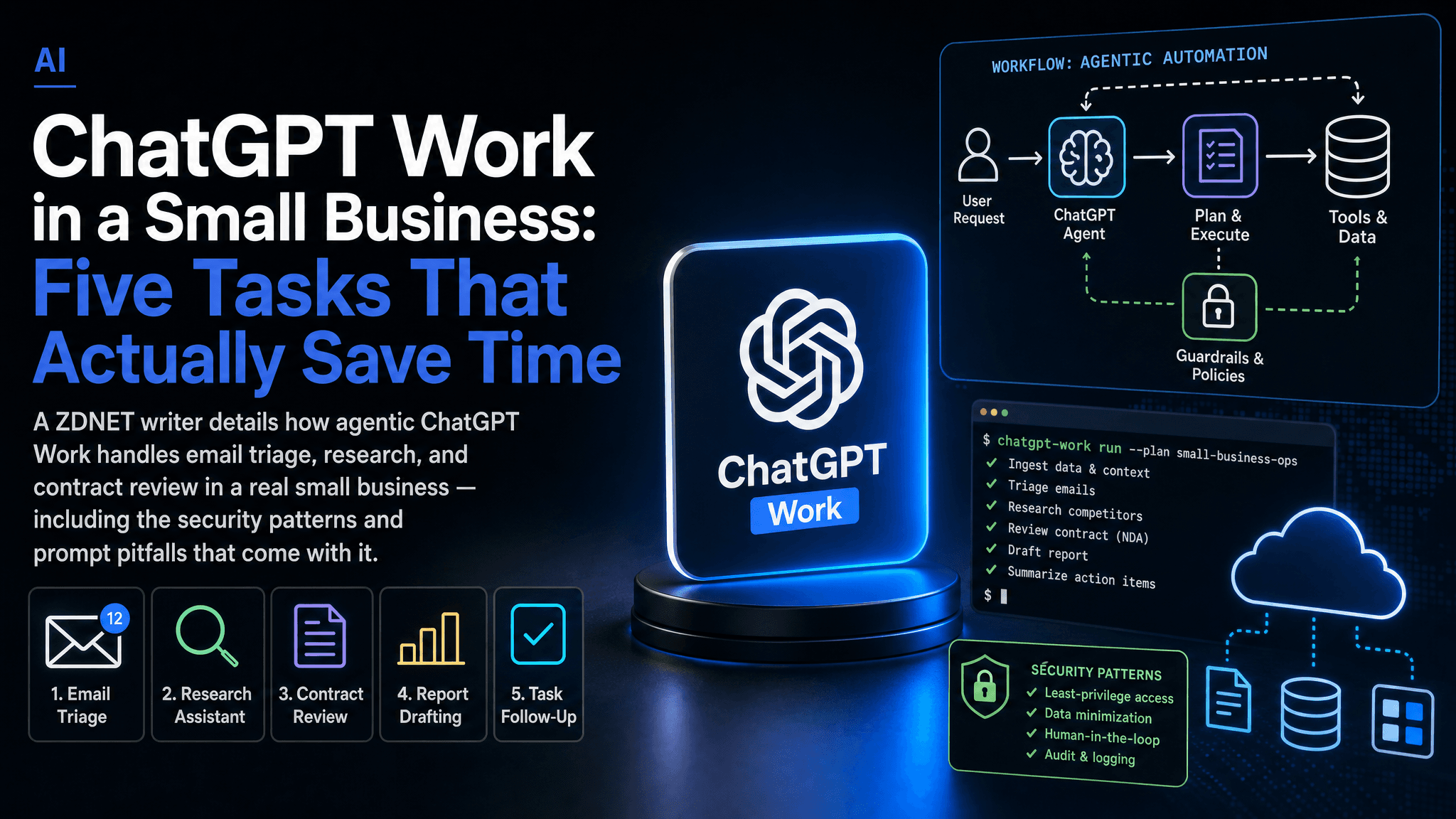
A ZDNET writer details how agentic ChatGPT Work handles email triage, research, and contract review in a real small business — including the security patterns and prompt pitfalls that come with it.
ZDNET contributor David Gewirtz has spent the past few months running ChatGPT Work — OpenAI's agentic, multi-step assistant — against the day-to-day chores of his own small business. His write-up is one of the more honest field reports on agentic AI so far: five workflows that delivered real time savings, plus the friction, prompt tuning, and security tradeoffs that came with them.
What ChatGPT Work is being used for
The use cases are deliberately mundane. ChatGPT Work scans Gmail for conversational history, digs details out of PR email threads, catches unfavorable loan terms in contracts, and handles other multi-step chores that eat hours without requiring deep judgment. Gewirtz's assessment: the value comes from agentic workflows, where the AI takes several actions in sequence rather than answering a single prompt.
The Gmail connection: useful, but handled carefully
The most operationally interesting part is how he manages the risk of linking Gmail to an AI agent. The connection gets enabled only immediately before a large assignment, then disabled the moment the task is done. He admits the manual enable-disable cycle adds friction — it's also what made him comfortable using the connector at all.
The email work itself is practical: pulling relevant details from a flood of AI-related PR correspondence. It's also where a real limitation surfaced. His first prompt asked for a summary of the last five messages from OpenAI's PR people, and it quietly missed most of the relevant mail. OpenAI primarily uses an external PR agency rather than in-house staff, and ChatGPT Work interpreted the request literally. A revised prompt with more explicit context fixed it. The lesson: connector-based agents do what you say, not what you meant. Prompt precision directly determines result quality.
Reading contracts and catching bad loan terms
Contract review may be the standout use — specifically flagging ugly terms in loan agreements. A small business without in-house counsel on retainer for every document gains real savings when an agent flags problematic clauses before signing. The report's own caveats still apply: results need human review. Agentic AI can surface a suspicious clause. It cannot replace a lawyer's sign-off on a binding financial agreement.
What the report doesn't measure
One gap worth noting: the piece is qualitative. There are no hard numbers on hours saved or dollar amounts, and the loan-contract example is described at a high level without the specific terms that were flagged. ZDNET promises deeper dives on individual projects — for both ChatGPT Work and Anthropic's Claude Cowork, which Gewirtz has also been testing — in coming weeks, so quantified results may follow.
What this means in practice
For engineers and small-business operators evaluating agentic AI, this report is a useful reality check. The wins concentrate in unglamorous, high-volume chores: email archaeology, document triage, contract pre-screening. The costs are just as concrete. Connector credentials need disciplined toggling, prompts must be written more explicitly than intuition suggests, and a human has to verify anything consequential before acting on it. The pattern isn't "AI replaces the assistant" — it's "AI does the first pass, the human does the judgment," with security hygiene around data connectors as the price of admission.
Comments
Sign in or create an account to leave a comment.
0 comments
No comments yet.