/news/debian-votes-to-permit-responsible-generative-ai-use-65cdacd0
Debian Votes to Permit Responsible Generative AI Use
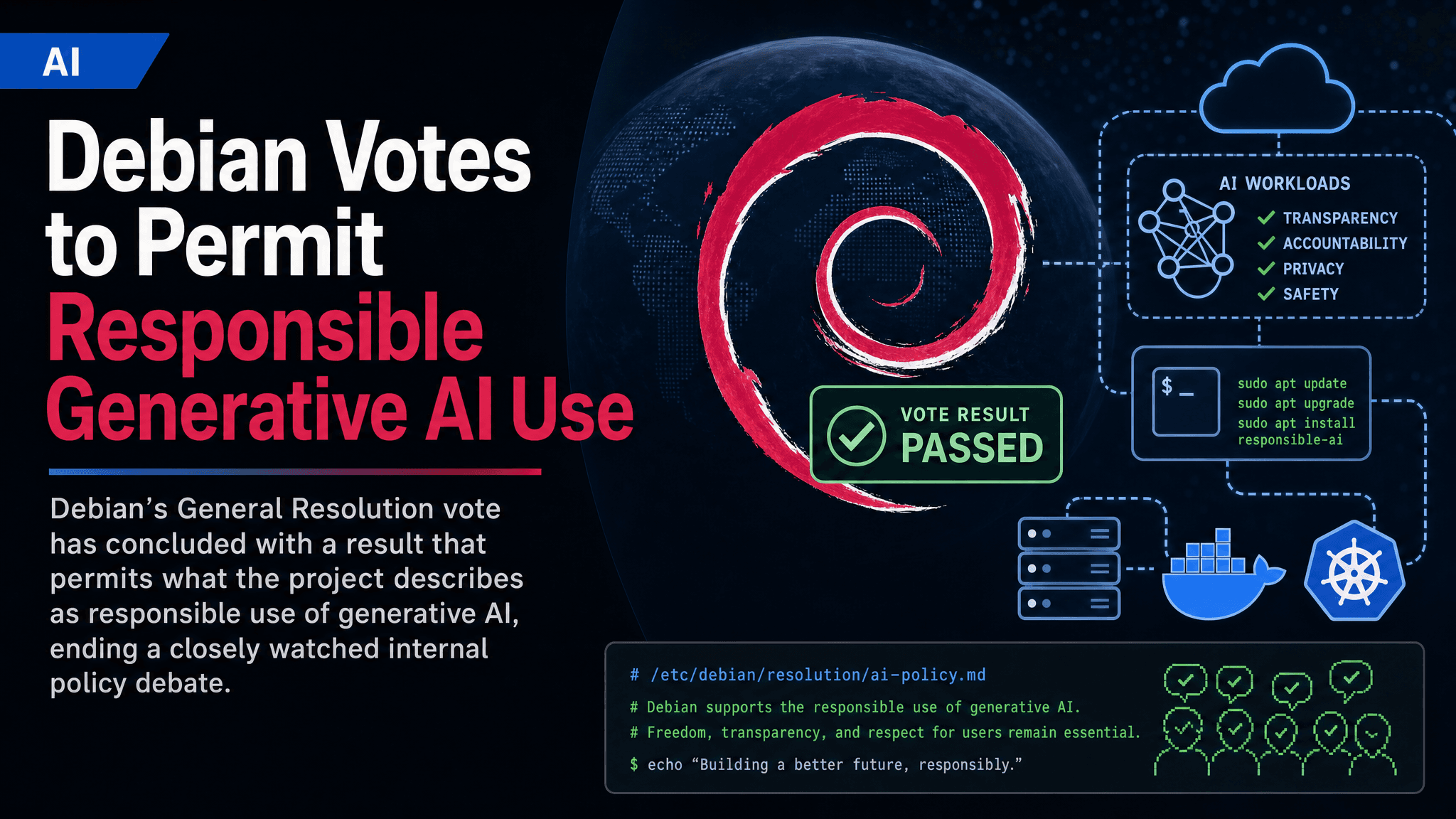
Debian’s General Resolution vote has concluded with a result that permits what the project describes as responsible use of generative AI, ending a closely watched internal policy debate.
Debian has concluded its General Resolution vote on generative AI policy. The winning position allows what is described as the responsible use of generative AI within the project.
The result matters because Debian’s technical and social decisions affect package maintainers, downstream distributions, infrastructure operators, and contributors who depend on its governance process as well as its software. The vote answers a debated project-wide question over whether, and under what broad principle, generative AI can be used in Debian-related work.
Phoronix reported that voting had finished and a winner had been determined in the Debian General Resolution process. The available report identifies the outcome as permitting responsible generative AI use. It does not provide the full adopted text, vote totals, or a detailed implementation plan in the source material available for this article. Those details will matter when Debian publishes or formalizes practical policy.
What Debian has decided
At a high level, the decision does not endorse every generative-AI workflow. The qualifier matters: Debian has voted to allow responsible use.
That leaves room for AI-assisted tools while keeping contributors accountable for submitted work. Debian’s outputs include source packages, patches, documentation, bug reports, translation work, infrastructure changes, and release processes. Responsibility has different consequences across those areas.
Generative AI can produce code and prose quickly, but it cannot assume responsibility for correctness, provenance, licensing, security consequences, or alignment with an existing project’s practices. A policy centered on responsible use keeps human judgment central. It does not treat machine-generated output as automatically acceptable or prohibited.
The vote also settles a governance question that had become contentious enough to reach Debian’s General Resolution process. General Resolutions are used for decisions that require a project-wide answer instead of an informal convention among individual teams. Contributors now have a stated direction from the project rather than having to infer whether AI assistance is categorically unwelcome.
Why the wording matters for maintainers
For maintainers and reviewers, the practical issue is usually not whether assistance was used in the abstract. They need to know whether a maintainer can explain and support a patch, whether generated output received the same review as any other contribution, and whether a change creates security, compatibility, maintenance, licensing, or attribution problems.
The reported outcome does not replace those responsibilities. It establishes that generative AI use can be compatible with them when used responsibly.
A universal technical ban would also be difficult to enforce. Determining whether a short changelog entry, translation suggestion, documentation edit, shell snippet, or patch idea came from a generative model can be hard. Origin alone does not establish quality: a human-written patch can be unsafe, while an AI-assisted draft can be reviewed and corrected. Debian’s reported direction keeps attention on responsible contribution instead of judging each submission solely by the tool used to create it.
What remains unresolved
The vote result is not a complete operating manual. The available report establishes the broad outcome, not the detailed rules engineers will need for day-to-day work.
For example, the report does not establish whether Debian will require disclosure of AI assistance in every context, whether some contribution types will face stricter handling, how maintainers should document provenance concerns, or whether individual teams can set narrower rules for their workflows. It also does not specify how the project will treat output from models trained on material of uncertain legal status.
Those distinctions have operational consequences. Copying generated code into a security-sensitive package without review carries different risks from using a model to brainstorm a test case. Package metadata, copyright files, security fixes, release notes, translations, and user-facing documentation also have different requirements. Follow-on guidance will determine how consistently maintainers and contributors can apply the policy.
Engineers should not assume the vote authorizes unrestricted use of external AI services with project information. “Allowed” does not mean every dataset, prompt, hosted service, or generated artifact is suitable for every Debian task. Existing obligations around confidentiality, licensing, security handling, review, and project process still apply unless Debian explicitly changes them.
A practical approach for contributors
Until more detailed policy text or team guidance is available, treat generated material as an untrusted draft.
Review code line by line, run relevant tests, verify package and upstream conventions, and check generated documentation claims against primary technical sources. Do not rely on a model’s explanation of a dependency, security behavior, or license. Retain enough understanding to maintain a submitted change after it lands.
For maintainers, ownership remains the useful standard. If a contributor cannot explain a patch, reproduce its behavior, or establish that it is appropriate for Debian, producing it quickly does not make it suitable. A well-reviewed contribution should still be evaluated on its technical and policy merits.
What this means in practice
Debian’s vote gives the project a project-wide answer to an issue many open-source communities are still working through: generative AI is not automatically outside acceptable contribution, but its use must be responsible. That is a governance decision, not a shortcut around review or accountability.
For Linux engineers who contribute to Debian or build on it, the immediate change is clarity at the principle level. Detailed guidance is the next item to watch, because it will turn that principle into repeatable contributor and maintainer practice.
Comments
Sign in or create an account to leave a comment.
0 comments
No comments yet.