
/news/linux-7-3-rc1-lands-with-zen-6-enablement-btrfs-gains-and-steam-controller-drive-cc930180
Linux 7.3-rc1 Lands With Zen 6 Enablement, Btrfs Gains, and Steam Controller Driver
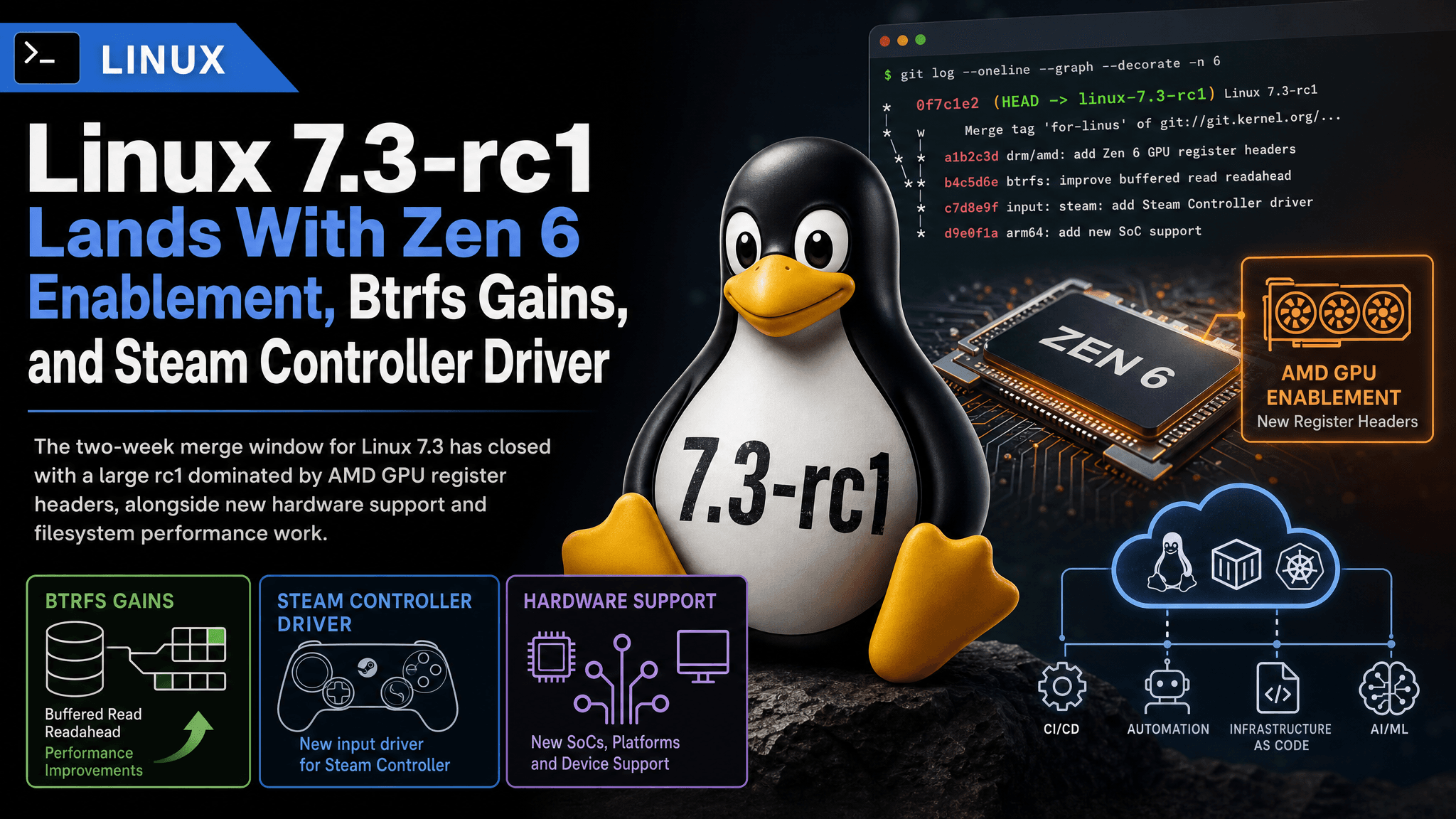
The two-week merge window for Linux 7.3 has closed with a large rc1 dominated by AMD GPU register headers, alongside new hardware support and filesystem performance work.
The Linux 7.3 merge window wrapped up on schedule after two weeks, and Linus Torvalds has tagged the first release candidate. By his own account it is a big one — not the largest rc1 ever, but "certainly up there" in commit count. Most of the raw diff size traces back to a familiar culprit: a massive dump of AMD GPU register headers.
A third of the patch is AMD DCN6 headers
Torvalds flagged the AMD DCN6 register header set as the single largest contributor to the rc1 diff. These headers are part of the enablement work for AMD's next-generation display and graphics IP, and hardware register dumps expressed as C header defines are inherently enormous. This time the AMD GPU code and header dump accounts for roughly a third of the entire rc1 patch. Strip that out, he says, and the merge window "didn't feel that different" from a typical one — large, but not anomalous.
That framing matters for anyone skimming diff stats: the headline size is inflated by generated-style hardware definitions rather than a surge of core kernel churn. Beyond the DCN6 headers, Linux 7.3 carries new AMD graphics IP enablement and broader support for upcoming AMD Zen 6 platforms.
What else is in 7.3
The merge window pulled in a wide spread of new hardware and feature work:
- Intel hybrid CPU optimizations, plus initial enabling around Intel "Starfire" and out-of-the-box enablement of Intel Xe3P graphics on Nova Lake.
- Apple silicon: initial M3 Ultra, M3 Pro, and M3 Max support.
- Filesystems: Btrfs performance improvements land in this cycle.
- Gaming and input: kernel driver support for Valve's 2026 Steam Controller, and gaming improvements from Valve targeting systems with very limited amounts of video RAM.
- Graphics userspace path: Nouveau gains support for NVK Vulkan Video.
- Security and storage: security improvements throughout, FailFS is now upstreamed, and USB4STREAM gets a low-latency mode.
Old and obsolete hardware drivers continue to be cut as well. Torvalds and the Phoronix coverage both note ongoing noise from AI/LLM-driven activity in the tree — including a wave of fixes attributable to LLM-assisted contributions — which has accelerated the cleanup of legacy drivers and shows up in the unusually high volume of fix commits this cycle.
Torvalds' own hiccup
In his release message, Torvalds admitted to making the merge window harder on himself by running a system upgrade midway through and then chasing down the issue it caused. Self-inflicted, and resolved without harm. His hope for the remainder of the cycle is a small, uneventful rc series, though he notes he is "not kidding anybody" expecting that. The practical implication is a normal seven-rc cadence pointing to a stable Linux 7.3 release around early-to-mid October 2026.
What to watch next
Phoronix notes that its exhaustive feature overview of Linux 7.3 is still to come, and Torvalds' comments arrived after rc1 was initially announced via Git. Until deeper benchmarking lands, the safe read is straightforward: if you care about Zen 6 platform bring-up, next-gen AMD display silicon, Apple M3-series support, or the 2026 Steam Controller, this is the cycle where the groundwork arrives. Btrfs users should also keep an eye on performance testing as the rc series stabilizes.
Linux 7.3-rc1 is available via Git for testing. Treat it as a development snapshot, as with any rc1. The value of this cycle's big header dump is that hardware enablement starts baking early, giving downstream distributions a longer runway before 7.3 goes stable.
Comments
Sign in or create an account to leave a comment.
0 comments
No comments yet.