/news/linux-7-3-tpm-cleanup-lays-groundwork-for-trenchboot-c6d61c24
Linux 7.3 TPM Cleanup Lays Groundwork for TrenchBoot
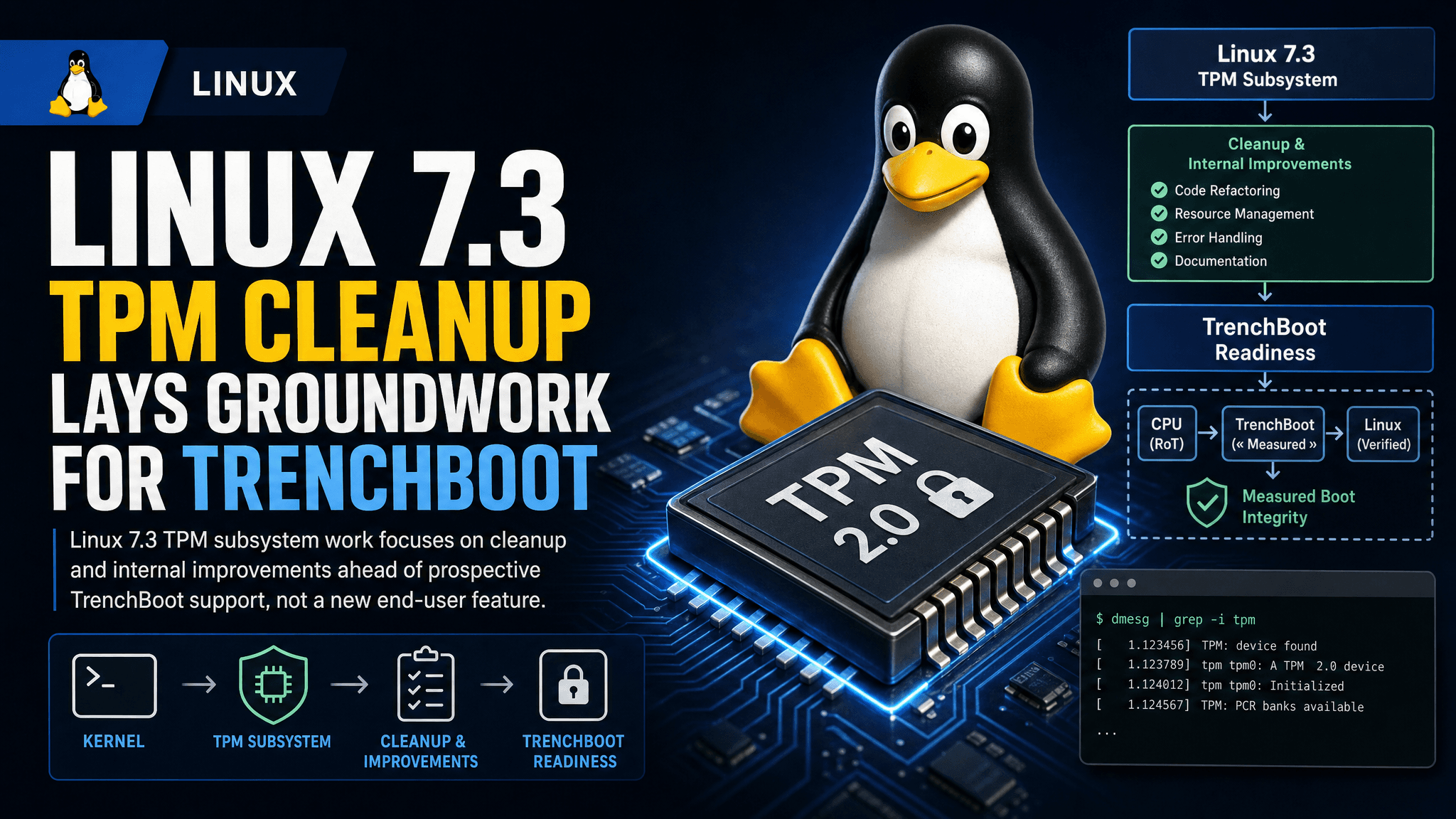
Linux 7.3 TPM subsystem work focuses on cleanup and internal improvements ahead of prospective TrenchBoot support, not a new end-user feature.
Linux 7.3 is set to include Trusted Platform Module subsystem cleanup intended to prepare the codebase for TrenchBoot support. The reported changes are groundwork; they do not indicate that TrenchBoot is fully supported in the mainline kernel.
Engineers planning measured-boot or platform-attestation deployments should keep that boundary in mind. The near-term benefit is a TPM subsystem that is easier to extend and maintain. A practical deployment still depends on eventual TrenchBoot integration and the surrounding boot-chain tooling.
What is changing in Linux 7.3
According to the Linux 7.3 TPM subsystem update, the work centers on code cleanup and improvements that precede TrenchBoot support.
The available announcement does not identify a user-facing TPM command, driver capability, policy interface, or TrenchBoot workflow. Upgrading to Linux 7.3 is therefore not, on its own, a reason to revise TPM provisioning procedures, alter PCR policies, or expect a new measured-boot interface.
Cleanup work can seem minor in a kernel changelog, yet it often determines whether a larger feature can land cleanly. TPM code touches firmware behavior, security policy, device-driver interfaces, and early boot. Resolving structural assumptions before introducing a boot-security framework is safer than layering a large integration onto code that still needs rework.
For maintainers, this points to upstream TPM development making room for TrenchBoot-related work instead of leaving it as an isolated downstream integration.
Why TrenchBoot is relevant
TrenchBoot is associated with a more verifiable boot path built with hardware security capabilities, including TPM-backed measurements. Measured boot records software or configuration states in TPM Platform Configuration Registers (PCRs). Those measurements can be used locally or sent to a remote-attestation system as evidence of a machine's boot state.
A TPM being available to applications does not by itself provide a complete, useful measured-boot chain. A system may use a TPM for key protection, disk-unlock workflows, or credential storage without supporting boot attestation. A trustworthy design also requires a defined measurement sequence, policy for acceptable values, and a verifier that can interpret the evidence.
Linux 7.3 does not establish those operational pieces. It is preparatory kernel work. The direction remains relevant for operators building higher-assurance Linux systems where boot integrity is part of the security model.
What this does not mean for current deployments
Teams should not treat the cleanup as an immediate security-feature delivery. The source gives no indication that Linux 7.3 introduces a finished TrenchBoot deployment path, changes TPM ownership practices, or replaces existing secure-boot and measured-boot tooling.
Hardware and firmware variables also remain. TPM versions and implementations differ, and firmware can affect measurements before Linux starts. A remote-attestation service still needs careful lifecycle management for identities, certificates, expected measurements, and recovery procedures.
Deployments using TPM-backed disk unlock or application secrets should evaluate Linux 7.3 through their normal kernel qualification process. The reported direction alone does not establish a behavior change for those workflows. Security-sensitive fleets should test updates against their firmware, bootloader, initramfs, TPM policy, and recovery paths rather than assume internal cleanup is operationally invisible.
A useful upstream signal
The significance is largely about upstream sequencing. Security-oriented boot projects can require changes across firmware, bootloaders, the kernel, userspace tooling, policy services, and attestation infrastructure. Kernel preparatory patches are only one part of that chain.
For Linux platform engineers, upstream preparation may be more useful than a one-off integration because future support is more likely to remain maintainable across kernel updates. It can also give distributions and hardware vendors a clearer route to package, test, and document the necessary pieces once the broader capability is ready.
Early groundwork offers little for an administrator to configure today, but it can create review and regression-testing work for subsystem maintainers. That is common with security infrastructure: the visible feature often follows refactoring that reduces the complexity of landing it.
What to watch next
Organizations interested in measured boot should watch for follow-on patches that explicitly describe TrenchBoot support, user-visible interfaces, required configuration options, and interactions with bootloaders or attestation services. Those details will determine whether the technology fits a particular fleet.
Before adopting a future integration, engineers will need practical answers: which TPM hardware is supported, what is measured and when, how PCR policies are managed, how evidence is verified, what happens after firmware or kernel updates, and how a machine is recovered when expected measurements change. The Linux 7.3 cleanup notice does not establish those details.
Linux 7.3's TPM work is a foundation story. It does not yet change how most systems use TPMs, but it shows upstream preparing the subsystem for TrenchBoot-related boot-integrity work. Teams with long-term attestation requirements should track follow-on work. Others can treat this release as a maintenance-oriented step rather than a new deployment requirement.
Comments
Sign in or create an account to leave a comment.
0 comments
No comments yet.